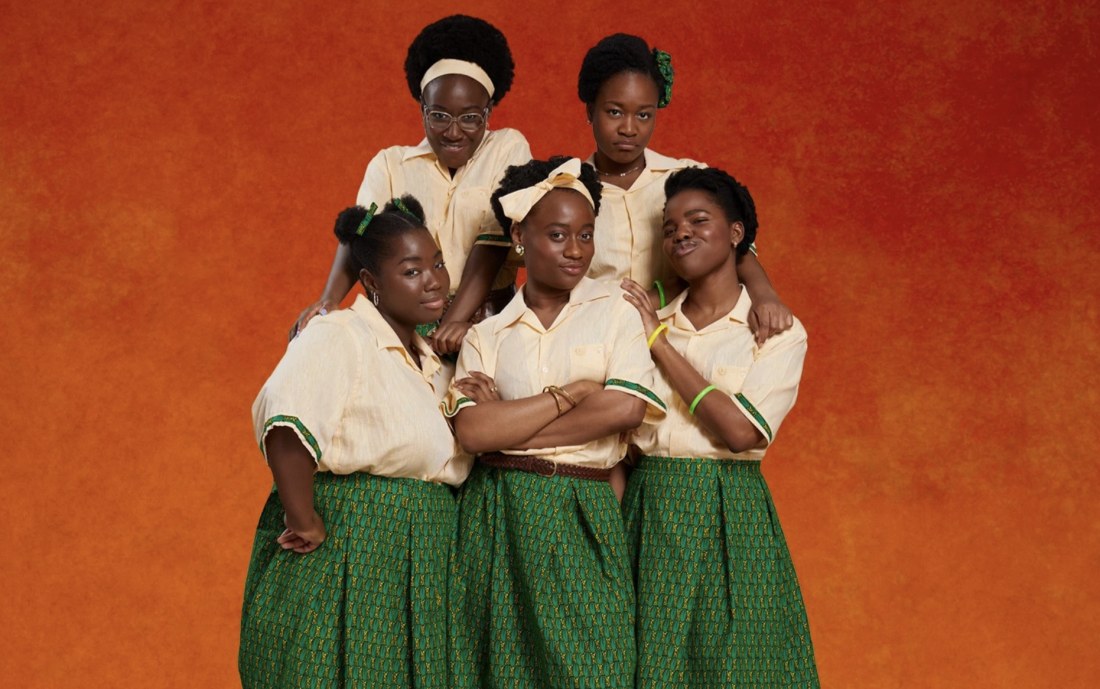
School Girls; Or, The African Mean Girls Play is an award-winning comedy play about a group of girls in a prestigious Ghanaian boarding school set in 1986, written by Jocelyn Bioh and directed by Monique Touko.
School Girls; Or, The African Mean Girls Play has already caused a buzz for its clever ability to make audiences laugh out loud while delving into topics around body image issues, colourism and class.
In the opening scenes, the audience is treated to a vibrant dance number as the cast move tables and chairs in a careful choreography around the stage to traditional Ghanaian music. This, along with the glowing lights, depicts the joy of the students as they move with each other, taking up all of the space on the stage.
As the title suggests, audiences may see parallels between this play and noughties teen comedy Mean Girls. However, this time, we have a fully Black cast of characters. In this version, the story is set within the prestigious (and real life) Aburi Girls Boarding School and the girls have an opportunity to win an upcoming Miss Ghana pageant to get them out of their less-than-glam lives. Anticipating the arrival of the Miss Ghana pageant recruiter, “Queen Bee”, Paulina (played by Tara Tijani) and her crew are confident that she will be picked. However, Paulina’s position is threatened by beautiful light-skinned new kid on the block, transfer student Ericka (Anna Shaffer). Who will be chosen to take part in the Miss Ghana pageant?
“Gripping and engaging from the start”: reviewing Jitney, an August Wilson play
The subtle tension between the girls as they fight for the recruiter’s attention led to many laughs from the audience who enjoyed the side eyes and mocking tones of the characters. However, this tension bubbled into an explosive standoff amongst the girls, particularly Ericka and Paulina when the recruiter arrived.
The storyline takes the wonderful opportunity to engage the audience on beauty ideals, colourism, social class and body positivity and discrimination to justify who most deserved to be picked.
I particularly enjoyed the role and performance of Headmistress Francis. Played by Alison A Addo, Headmistress Francis is the voice of reason, encouraging the girls about the importance of finishing school. Addo did a wonderful job of advocating for them to focus on their studies instead of fighting over a beauty competition. It was heart-warming to see an older Black teacher having a positive relationship with their students.
Beautiful and uplifting: Reviewing “Sulwe” Lupita Nyong’o debut book
The audience enjoyed the chemistry among the cast. However, it should be noted that the accents did not reflect the country of origin, in my opinion.
The play brilliantly touched upon the strife of Black girlhood and revealed a deeper layer of the desires of each character. This included family acceptance, friendships or success. For the headmistress, her altruistic goal was for her girls to be educated and thrive.
“I had a really long journey to owning my beauty as a Black woman, as a dark-skinned Black woman specifically…”
In the promo for the play, the play’s writer, Jocelyn Bioh, talked about some of the similarities of her lived experience and the motivation to highlight some of the topics covered in the play. She said: “I have a lot of unique relationships to this play. One is that I also went to boarding school myself. Aburi Girls Boarding School is actually a real boarding school and it’s the school that my mother went to in Ghana. It’s one of the few things that she and I have in common that we both were young Black girls in boarding school with other girls who looked like us.
“I had a really long journey to owning my beauty as a Black woman, as a dark-skinned Black woman specifically. I knew I wanted to write about what that felt like. It was really an exploration too. I know who I am, I own my beauty, I own who I am in the world but, God it would have helped me so much more if I maybe had a play like this and for me to have seen it at a critical time, like when I was a teenager.”
I really enjoyed the play. It was a joyful and self-affirming production covering important body image issues, colourism and Black girlhood.
About the play
School Girls; Or, The African Mean Girls Play is showing at Lyric Hammersmith Theatre until 22 Jul 2023
Book here
Written by Mariam Onayiga